| | |

Meeting with WFTO Asian
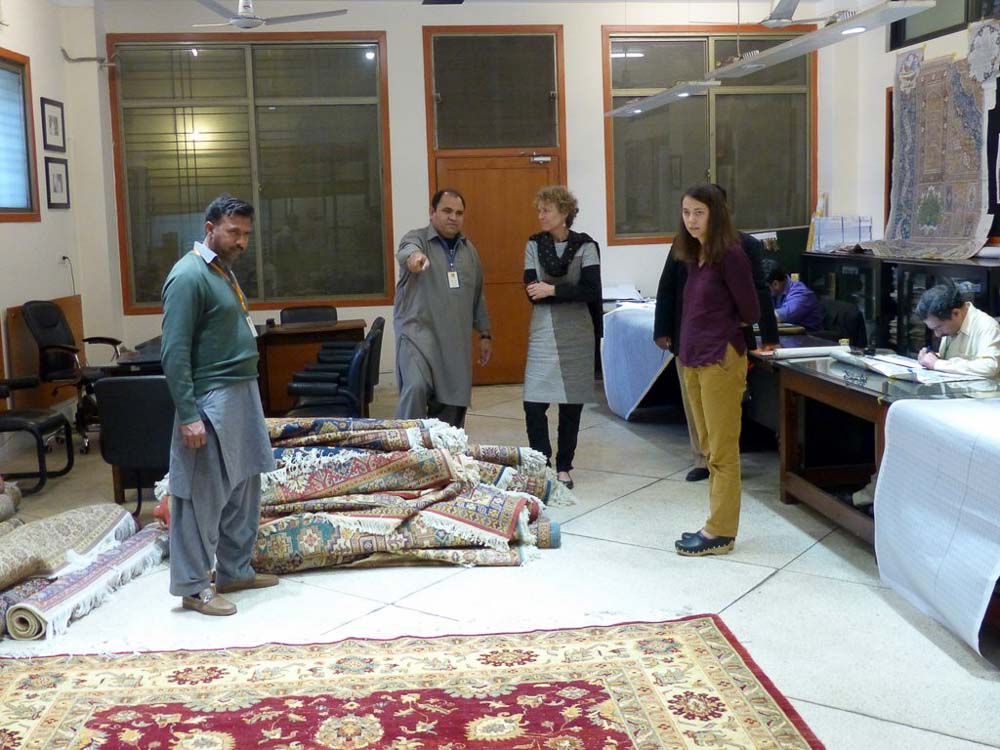
Yousaf is explaining the rug making process to Christine and Elise of WFTO Asia.
This morning Christine Gent and Elise Hawley from the World Fair Trade Organization (WFTO) Asia office in Chiang Mai, Thailand came to visit us at Bunyaad. Christine and Elise are in Pakistan to visit the one WFTO member in Pakistan (Habitat Integrated Pakistan (HIP)) and to possibly recruit new members.

In the past, Christine has done product design and development work for Ten Thousand Villages in Haiti and Sri Lanka. She contacted us via her Villages connection hoping to find potential new WFTO members in Pakistan. We explained Bunyaad’s work to Christine and Elise and showed them around the building.

Wajid rolling out rugs for Christine and Elise to view.

Christine and Elise also presented information about WFTO and the new Fair Trade Guarantee System that certifies members as bona fide fair trade organizations. They encouraged us to consider membership in WFTO. Christine said that she thought Bunyaad could qualify for membership quite easily. However, we’re not sure that the benefits would outweigh the costs. We are already a member of the Fair Trade Federation (FTF) in the USA and feel like this is more than enough for Bunyaad at this point in time.

While showing our WFTO visitors around the Bunyaad building we observed a couple of customer rugs being repaired. These were rugs purchased by customers several years ago which were sent back to Pakistan for expert repair work. This exhibits the comprehensive customer care that Bunyaad offers to rug customers.

Repairing the fringe of a rug returned to Pakistan. After the repair is complete the customer will have a like-new rug.
Precise and painstaking hand work is needed to repair the fringe of this rug.

Close attention to detail is needed in order to produce top quality handmade rugs. Some of the rugs are a little bit ‘crooked’ when they are cut from the loom. In order to ensure that rugs are perfectly symmetrical and square they are carefully measured and then stretched into the correct shape, if necessary.

A Kazak rug is carefully measured and then nailed to the stretching platform before being stretched into the correct shape.

We had a good visit with Christine and Elise of WFTO Asia and learned a few new things about WFTO membership. Even though we will not join WFTO at this time, we will keep in touch and try to learn as much as possible from each other. In fact, the way that Bunyaad practices fair trade in Pakistan could be a good model for WFTO members to follow.

Stay tuned for Doug’s next trip post

We hope you’ve been enjoying the notes, experiences and photos and have been able to follow our adventures on the Bunyaad blog so far. Stay tuned for more.

Sign up to receive the next story in your inbox:

STAY IN THE LOOP: fair trade, rugs, sales & events.

Here is a link to all of the posts: Read Pakistan Learning Tour

Similar Posts

  • | |

    Natural Dye for Eggs and Rugs

    The natural dye on the eggs goes well with this Persian rug.

    Have you ever tried your hand at dyeing eggs with natural dyes?

    Naturally dyeing eggs is truly a labor of love. It speaks to my instilled love for eating healthy. Collecting and prepping all the ingredients like onion peels, purple cabbage and chopped beets shows dedication. Allowing the eggs to simmer in their dye bath for 30 minutes or even overnight for truly stunning deep colors is worth the wait.

    When I look at our naturally dyed Chobi Tribal rugs and our Kazak Tribals, I have a new appreciation for the amount of work that goes into producing one of these rugs.

    Naturally dyed chobi rugs are roughly 100 knots per square inch but take the same amount of production time as their Persian counterparts at over 500 knots per square inch.

    The preparation for getting a Chobi on the loom is over half of the time needed for the rug’s production, where as it takes less than 10% of the total production time of a Persian to get it on the loom.

    What takes so much time to get a Chobi on a loom?

  • The Dougs Arrive in Lahore, Pakistan

    Doug Horst and Yousaf Chaman

    We (Doug Horst & Doug Dirks) left Lancaster, PA at 4 pm on November 10 and drove to JFK airport in New York with Marion Schrock serving as our airport driver. We checked into our Emirates flight at 9:30 pm and were in the air by 11 pm.

    After 11 hours in the air we landed in Dubai to change flights and take off again for Lahore, Pakistan. Our flights were smooth and uneventful and we easily cleared customs and picked up our bags in Lahore. We were very happy to see the smiling faces of Yousaf and Ehsan as we exited the airport baggage area. It was 3 am on Thursday, November 12, by the time we reached the Chaman family home in Saeed Park.

    We enjoyed a breakfast of fried eggs,
    coffee, saag and chicken.

    By 4 am we gladly fell into bed after more than 24 hours of total travel time. Doug and Doug work up late, just in time to have “breakfast” at 2 in the afternoon. After enjoying a breakfast of fried eggs, coffee, saag (spinach) and chicken we (Yousaf, Doug and Doug) drove to the Bunyaad/JAKCISS office and warehouse to pick up Ehsan.

  • |

    Bunyaad Learning Trip – Before Departure

    Female Bunyaad Rug Knotter

    On November 10, Doug Horst and I (Doug Dirks), from the Bunyaad office at Ten Thousand Villages in Ephrata, Pennsylvania, will fly to Pakistan to visit rug makers and learn about rug making. We will join Yousaf Chaman who traveled to Pakistan a week earlier.

    We are very much looking forward to this two week trip because we will meet rug makers and their families in their homes, right where Bunyaad rugs are created. This will help us to better understand how rugs are made, who makes them and under what circumstances they are made. We’ll get to visit and stay in rug making villages so we can soak up local culture and enjoy wonderful village hospitality. The food will be delicious and the conversations will be delightful.

  • |

    Hot Steaming Water Buffalo Milk served by Fauzia

    Fauzia steams milkWhen you come to any of our rug rooms and during all of our rug events across the US and Canada you get a glimpse into the world of rug making and see the artisans at work in the video “Introduction to Oriental Rugs” that is shown throughout the day. As staff I have watched this video hundreds of times. My work in the Bunyaad office also involves working with lots and lots of artisan photos. So when visiting Pakistan this year it felt almost surreal meeting these same artisans for the first time and yet feeling like I have known them for a long time.

    It is with great pleasure that I get to introduce two of these young women to you who have both been rug knotters with Bunyaad for the past eight years. Fauzia and Sofia live with their parents in the small village of Halwan about two hours north of Lahore. After finishing their schooling, they both started knotting rugs as this allowed them a good income and the ability to stay home with their parents.

  • | |

    The Dougs learn about Education and Washing Rugs

    Students lined up for the beginning of the school day at St. John’s.

    After a hearty breakfast at the Chaman home we walked across the street to visit St. John’s school. The school is on the same property as St. John’s church. The school has 168 students from Kindergarten to grade 10 and 13 teachers. Families that can afford to pay a small monthly tuition. Families that can’t afford to pay can send their children for free. The Principal, Ms. Mehrul Nisa, said that 60% of the students go on to college.

  • |

    Fair Trade is a Revolution

    bumper-sticker-fair-trade-revolution

    “A bond with customers based on shared values is the strongest bond you’ll ever make,” stressed Ben Cohen, co-founder of Ben & Jerry’s and currently working with Stamp Stampede, a venture dedicated to getting the money out of politics.

    Sitting in the room with over 280 other fair traders at the Fair Trade Federation Conference in Burlington, Vermont last week, I almost stood up and shouted “AMEN.”

    Renee Bowers, Fair Trade Federation Executive Director, opened that morning sessions reminding us that “as fair traders, we work to give voice” to those who otherwise would not have as loud of a voice in the world.

    And in this week where we celebrate World Fair Trade Day, I want to say thank you to our customers who are using their economic dollar to vote for the change they wish to see in the world.