| | |

The Dougs Say Goodbye and Farewell Pakistan

Doug and master designer
Chohan, master rug designer at Bunyaad, with Doug Dirks.

We enjoyed a great time in Pakistan. Everywhere we went we met friendly, helpful and incredibly hospitable people.

It seemed like everyone wanted to shake our hands and give us a hug. On Sunday afternoon, while touring the old Lahore Fort, a number of people wanted their pictures taken with us. Contrary to what we hear and read in the media about Pakistan, it’s a great place to travel – safe, friendly, hospitable and very scenic.

Pakistani children.
Friendly, enthusiastic kids from rug making families in Chistian.
Yousaf and Afaq descending the steps on the way out of the Yousaf and Afaq walking out of Lahore Fort with crowds of friendly people on a Sunday afternoon outing.
Even the street side shoe repair man was happy to meet us, even though he could not fix Doug Horst's shoe.
Even the street side shoe repair man was happy to meet us, even though he could not fix Doug Horst’s shoe.
Badshahi Mosque in old Lahore. Total capacity is 100,000 worshippers. Minarets are 196 feet tall.
Spectacular mountain scenery from Shugran, on the way back from Jared.

Traffic was a bit more chaotic than we are used to but we never felt in danger. Our drivers, Ehsan and Yousaf, were safe, careful drivers and courteous to other drivers. Driving on the M2 Motorway between Lahore and Islamabad was smooth, fast and orderly. The M2 in Pakistan put the Pennsylvania Turnpike to shame.

Traffic in Lahore.
Traffic in Lahore.
The M2 Motorway between Lahore and Islamabad.

The food was delicious and we ate our way through a wide variety of Pakistani cuisine. Street food in Lahore, Balakot, Kallar Kahar and everywhere else we stopped for a snack was especially good – pakora, jalebi, samosa, shawarma and a host of other delights were all delicious.

Roadside jalebi stand on the way to Chistian – delicious hot, sweet snacks.

The work of Bunyaad in Pakistan is truly impressive. Fair trade at Bunyaad is alive and well. Bunyaad works with over 800 families of rug makers in more than 100 villages. These people range from families that have generations of rug making experience to brand new folks like the young women in training at the Jared Training Center. All of them need to work to properly support themselves and their families. Most do not have viable alternate job opportunities.

Fair trade at Bunyaad
is alive and well.

The relatively new members of Bunyaad in Chistian have been pushed out of the town into a new community that does not have electricity nor safe drinking water. Bunyaad choose to work with these people because they have no other work opportunities. But, they do have rug making skills that make them valuable members of the Bunyaad family. Hopefully, successful rug making will lead to better living conditions and other benefits like good education for children and access to healthcare for everyone. In the future, electricity and safe drinking water should be available to everyone.

Ghullam Mohammad with his grandkids at the new Jared Training Center.
Some of the 16 young women taking rug making training in Jared. They will be able to support themselves and contribute to their family's well-being.
Some of the 16 young women taking rug making training in Jared. They will be able to support themselves and contribute to their family’s well-being.
Ehsan, Rasoom, and Mr. Shah enjoy working together in Chistian.

We truly can say that
Bunyaad rugs are amongst
the best in Pakistan.

The people who contract with Bunyaad to do wool dyeing and rug washing spoke highly of Bunyaad’s attention to detail, use of top quality raw materials (wool, yarn, dye), pursuit of near perfection in hand made rugs, encouragement of creativity and variety of design and desire to build strong, long-lasting relationships with everyone involved in the rug making process. We truly can say that Bunyaad rugs are amongst the best in Pakistan. As Wajid from the washing operation and Anayat from the dyeing workshop said, Bunyaad uses the best quality raw materials and produces the best quality handmade rugs made in Pakistan today.

Anayat and Yousaf are looking over Anayat's dye recipe books.
Anayat and Yousaf are looking over Anayat’s dye recipe books.
Washing a Bunyaad Chobi rug at Wajid's rug washing facility
Washing a Bunyaad Chobi rug at Wajid’s rug washing facility
Imran working on final small details of a 4 x 6 foot tree of life Persian rug.

When you buy a Bunyaad rug you can be confident that you now own one of the best quality handmade rugs in the world. In addition, you can feel good about the welfare of the people who made your rug in Pakistan. They were paid fairly, they were able to work in a good environment with their family and neighbors, they were able to access good education for their children and they are looking forward to a better future.

We are very grateful to Bunyaad for giving us this wonderful opportunity to meet rug makers in Pakistan. We can’t wait to return so we can visit with our new found friends all over Pakistan.

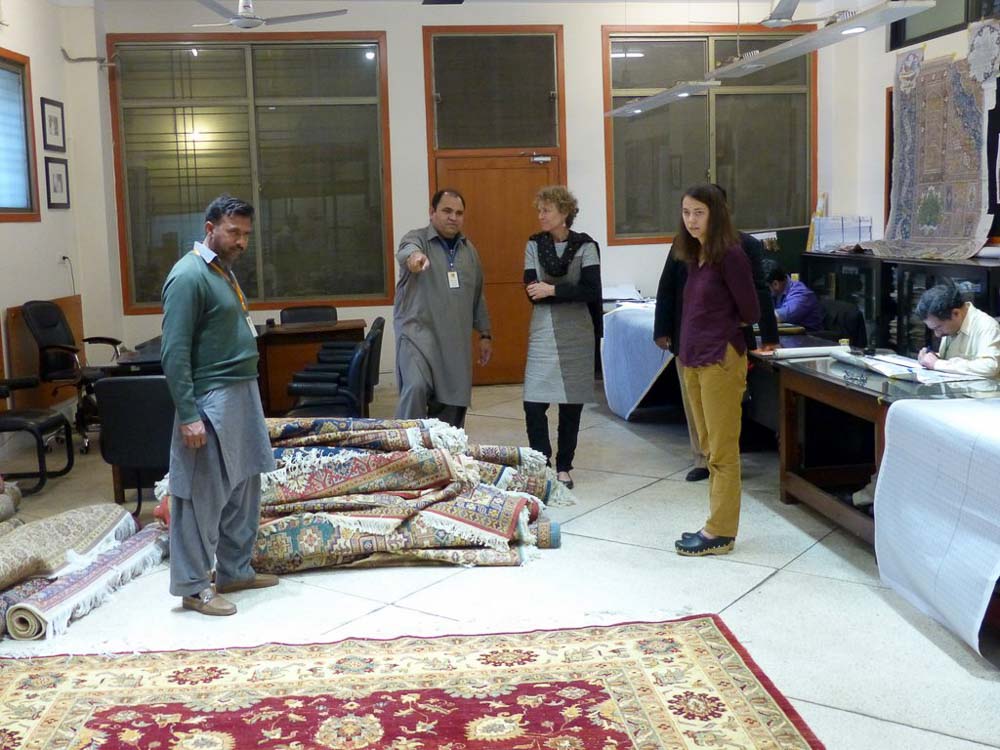
Rolling out a rug in the Bunyaad showroom that could be gracing your home someday.

Thank you for joining us on this journey

We hope you’ve been enjoying the notes, experiences and photos and have been able to follow our adventures so far. In case you have missed any of our posts, here is a link to all of the stories: Read Pakistan Learning Tour

Come and visit us at any of our four year-round stores or at one of our rug events across the US and Canada to see and purchase one of these beautiful and fairly traded rugs for yourself.

Similar Posts

  • Nothing Like A Fresh Mango

    It’s mango season here in Pakistan and there is nothing like a fresh mango. And nothing like a fresh mango lassi.

    Fruit seller cart

    Lassis are made with fresh yogurt, milk and mango. Sweet from the fruit and full of probiotics from the yogurt, a mango lassi is the go-to drink to cool off in Pakistan’s hot summers. As the world’s fourth largest producer of mangos, Pakistan has no shortage of mangos when they are in season.

  • | | |

    Meeting with WFTO Asian

    Yousaf is explaining the rug making process to Christine and Elise of WFTO Asia.
    This morning Christine Gent and Elise Hawley from the World Fair Trade Organization (WFTO) Asia office in Chiang Mai, Thailand came to visit us at Bunyaad. Christine and Elise are in Pakistan to visit the one WFTO member in Pakistan (Habitat Integrated Pakistan (HIP)) and to possibly recruit new members.

    In the past, Christine has done product design and development work for Ten Thousand Villages in Haiti and Sri Lanka. She contacted us via her Villages connection hoping to find potential new WFTO members in Pakistan. We explained Bunyaad’s work to Christine and Elise and showed them around the building.

  • | |

    Natural Dye for Eggs and Rugs

    The natural dye on the eggs goes well with this Persian rug.

    Have you ever tried your hand at dyeing eggs with natural dyes?

    Naturally dyeing eggs is truly a labor of love. It speaks to my instilled love for eating healthy. Collecting and prepping all the ingredients like onion peels, purple cabbage and chopped beets shows dedication. Allowing the eggs to simmer in their dye bath for 30 minutes or even overnight for truly stunning deep colors is worth the wait.

    When I look at our naturally dyed Chobi Tribal rugs and our Kazak Tribals, I have a new appreciation for the amount of work that goes into producing one of these rugs.

    Naturally dyed chobi rugs are roughly 100 knots per square inch but take the same amount of production time as their Persian counterparts at over 500 knots per square inch.

    The preparation for getting a Chobi on the loom is over half of the time needed for the rug’s production, where as it takes less than 10% of the total production time of a Persian to get it on the loom.

    What takes so much time to get a Chobi on a loom?

  • |

    Ephrata Rug Room under Renovation

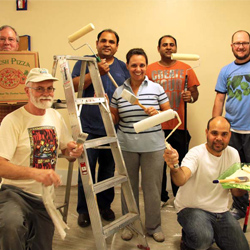
    RenoStaffThe Bunyaad Rug Room at Ten Thousand Villages in Ephrata is under a major renovation… painting, new flooring, the works!… but guess who is doing most of the reno…. Rug Room staff! We are finding that many of our staff have incredible hidden skills in painting tedious edges, organizing major fixture moves and otherwise keeping after a group of willing painters!

    Reno started today (updates being posted on our facebook page) and we quickly found that keeping after desk work while painting was quite difficult, especially when we had to disconnect our internet downstairs in order to paint the wall behind the router. 🙂 We will be closing this Saturday, August 1, at 3 p.m. so that we can really start making some major messes… and then we will reopen on Saturday, August 8 at 10 a.m.

  • Fair Trade Rugs: Creating a More Just World

    Artisan Rafia with daughter at loom

    I sit beside Rafia Nasir on the loom where she works on a 6×9 Persian rug with her two sisters.

    Rafia is a new mom, just like I am. She holds her nearly 8 month old little girl, letting her grab at the taut warp threads as she takes a break from her work. Rafia chuckles as I have to run and change my son’s diaper, tossing him down on her charpai, a rope bed, in the middle of her home and asking if she minds if I change him there. It’s my son’s first trip to the villages of Pakistan and at age 2, he’s taking it all in, including the chicken running into the house from the outside courtyard.

  • | |

    World Fair Trade Day – Why Should We Care, What Does it Mean for Us?

    bunyaad rug artisan family at the loom

    World Fair Trade Day (WFTD) recognizes and celebrates the impact of fair trade relationships around the world. The first World Fair Trade Day was established by the World Fair Trade Organization (WFTO) and celebrated on the second Saturday in May, 2002. Since then fair traders all over the world, including Fair Trade Federation (FTF) members, have celebrated WFTD on the second Saturday in May each year. This year, WFTD is on Saturday, May 9.

    Bunyaad is a recognized leader in fairly traded handmade rugs from Pakistan and we’ve been practicing fair trade since the 1960’s when Chaman Masih began working with just a few rug making families. Fair trade was not even part of the language back then. As time went along, Bunyaad joined forces with Ten Thousand Villages and the business of fairly traded rugs grew substantially. Just this year, Bunyaad became a member of the Fair Trade Federation and officially joined the North American and worldwide family of fair trade.

    So, why should we care about World Fair Trade Day? I think there are four main reasons:

3 Comments

  1. Fascinating trip report Doug! Will have to send the link to my niece Meredith who lives/works in Dubai and frequently visits Lahore for her work! She’d love to visit Bunyaad.

  2. Doug, it’s been great to read about your trip, all the best as you continue to support Bunyaad.

Comments are closed.